Elgar Enigma and Dorabella Cipher – A link between Dan Bartlett’s Dorabella Cipher Solution and Zackery Belanger’s Enigma Solution, plus Other Observations.
Introduction
I don’t have my own theory about Elgar’s ‘Enigma’ or ‘Dorabella Cipher’ puzzles. However, I do have some observations and additional material which I believe supports aspects of the existing theories by Zackery Belanger and Dan Bartlett on Elgar’s two most famous puzzles.
I believe I have established a link between Dan Bartlett’s solution to the Dorabella Cipher and Zackery Belanger’s theory regarding the hidden theme of the Enigma Variations, suggesting that the Dorabella Cipher foretold of the ‘Enigma’ behind the Enigma Variations, which were written about 18 months later.
Zackary Belanger’s theory on ‘The Enigma’
Zackery Belanger proposed in 2021 that the hidden theme of the Enigma Variations is one of Elgar’s own songs ‘Like to the Damask Rose’, and that the Dorabella Cipher was linked to this. (Please see https://www.dearcipher.space/). This idea involved some cryptography related to the Dorabella Cipher, but also based on the idea that the symbols in the Dorabella Cipher can be arranged to form the shape of a rose, which was what gave ZB the idea that ‘Like to the Damask Rose’ could be involved in the ‘Enigma’.
I am not persuaded by ZB’s analysis of the Dorabella Cipher, but I am convinced by his conclusion regarding the ‘Enigma’.
ZB noted that the song ‘Like to the Damask Rose’ refers to 14 things that die or are temporary, which could be connected to the 14 people described in the Enigma Variations, perhaps emphasising that they were all mortal.
ZB also believed that the main tune of the song ‘Like to the Damask Rose’ might work in combination with the Enigma theme. I believe that this is indeed true, if the counterpoint is approached in the right way.
Dan Bartlett’s work on the Dorabella Cipher
For a full explanation of Dan Bartlett’s work on the Dorabella Cipher, please refer to his book “Dorabella Cipher Solved” which is a fascinating read, available on Amazon in paperback and electronic form.
DB has published a detailed explanation on how the Dorabella Cipher can be understood by following a decryption process involving several logical steps, revealing five words, names and phrases, which would have been recognisable to Dora Penny (though not necessarily at the time when the cipher was first written and delivered).
This solution reveals ‘Edward Elgar’, ‘Lady Alice’, ‘Dorabella’, ‘Caroline’ and ‘Intermezzo’. Some of the letters are missing, but even with the missing letters it is still obvious what words and names are implied. It was the missing letters that aroused my curiosity for further investigation, and I believe these missing letters provide a link to the Enigma solution’.
My Involvement and Observations
During the lockdown of 2020 I developed my own theory concerning Elgar’s ‘Enigma’, but I have abandoned this after seeing the suggestion of ‘Like to the Damask Rose’, which I now believe to be completely plausible and the the best of all the proposed Enigma solutions.
I became aware of Zackary Belanger’s theory on ‘Like to the Damask Rose’ in 2022 and found the idea interesting in connection to the Enigma, although I did not understand the cryptography aspect of the work and was less convinced by the proposed solution to the Dorabella Cipher.
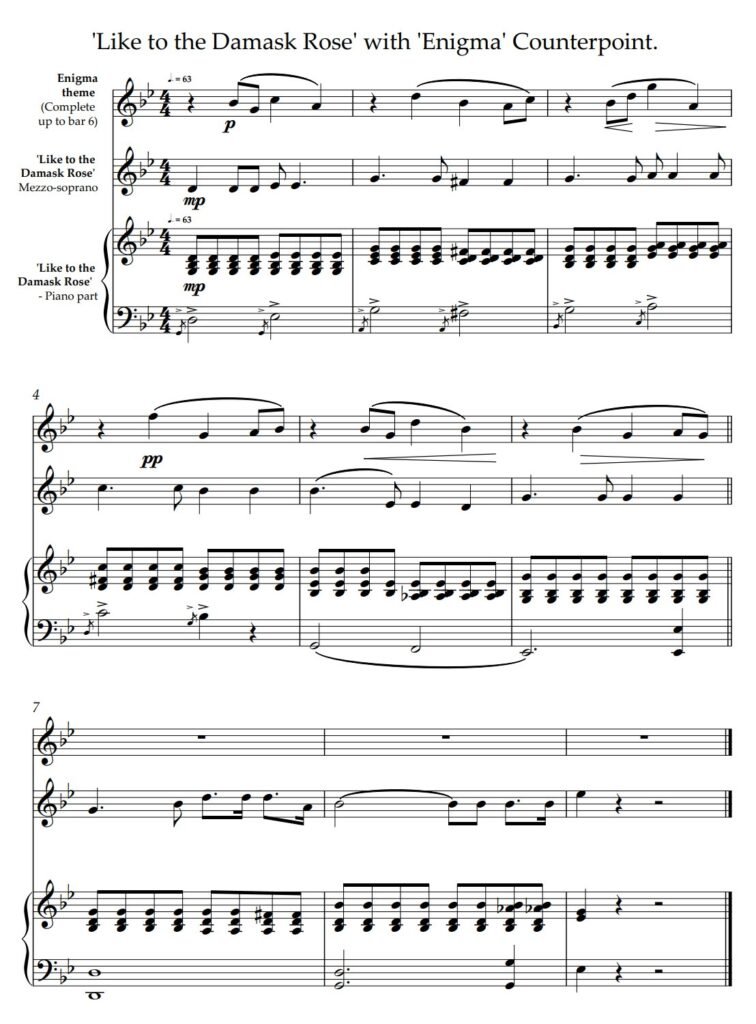
I was curious enough to test the potential counterpoint between ‘Like to the Damask Rose’ using score-writing software. I found that the first 6 bars of the Enigma top-line melody (ignoring all accompanying harmony) can be played above the Damask Rose music (including piano accompaniment) starting from the point where the singer enters, and this produces very satisfactory result, as you will hear in the sound clip below. Both pieces are in G minor, and have a 4/4 time signature and similar tempo.
I noted that with this combination there are some points that look quite discordant on paper, but which in context sound very acceptable and in keeping with the style for the period. The most discordant moment is the point at which pianissimo is marked in bar 4 of the Enigma theme, but I find the momentary clash quite pleasing as a ‘tension’. I also find the overall effect of this musical combination completely convincing as a serious piece of music, and consistent with Elgarian style. You can listen to it here:
I believe that Elgar’s statement that ‘it is very well known’ or ‘quite familiar’ really meant that it was very well known to him, not necessarily to the general public.
In addition, the fact that this solution involves other music written by Elgar himself completely changes the meaning of several of Elgar’s statements, including his statement to the Musical Times in 1900:
“Mr Elgar tells us that the heading Enigma is justified by the fact that it is possible to add another phrase, which is quite familiar, above the original theme that he has written.”
This has generally been interpreted as meaning that another tune can be played above the Enigma theme (including its chords), but when the missing theme is by Elgar himself, it can take on a different meaning where ‘Like to the Damask Rose’ is the ‘original theme that he had written’ and the ‘enigma tune’ can be the ‘other phrase’ above Elgar’s own music, particularly as the enigma theme had become ‘quite familiar’ by 1900.
Similarly, it is arguable that Elgar’s statement ‘through and over the whole set’ is open to interpretation. It is generally assumed that this refers to the set of variations, but Elgar did not actually say ‘the whole set of variations’. He might have been referring to ‘the whole set’ of 14 things mentioned in the song lyrics for ‘Like to the Damask Rose’, and the fact that another theme can be played over that song.
Is Enigma Theme derived from a missing violin part from ‘Like to the Damask Rose’?
I speculated that ‘Like to the Damask Rose’ might have originally have been written with a violin part in addition to the voice and piano, and that the violin part might have been discarded, only to be recalled later to form the ‘Enigma’ melody. As an amateur composer, I am well aware the ideas can easily be discarded and then recalled years later and re-used in a different context. More recently I have experimented to see how any such violin part might have worked and I believe that it is completely plausible that the Enigma theme was derived from such a part. I also note that Elgar did indeed write violin parts for at least one other song, which is the part song known as ‘The Snow’.
The Relevance of the Dorabella Cipher.
In October 2024, I attended a presentation in which Dan Bartlett explained his Dorabella Cipher solution in detail and revealed the results for the first time. This was very impressive, and I felt that it was highly probable that DB had been successful in cracking the code. The question that remained was ‘Is that the complete solution or is there more to be discovered?’ There were several observations suggesting that the cipher could hold a clue about the ‘Enigma’, as explained in Dan Bartlett’s book.
After obtaining DB’s book ‘Dorabella Cipher Solved’, I reminded myself of the process and solution, which I again found plausible. I then focussed on the missing letters of the solution which are as follows:
D A O A A R E M E
I tried various ways of re-arranging these letters without finding anything potentially meaningful apart from ‘DORA’, ‘EE’, ‘ME’, ‘ADORE’ and ‘AMORE’. I then realised that any further solution might have one, two or three letters missing in each word, as that would be entirely consistent with the previous results, as well as being consistent with Elgar’s habit of missing letters from words in his letters.
Eventually, I found the following configuration:
E..A.
DAMA..
RO.E
Accepting that there are some hidden letters in each of the rows, I first thought that this suggested the following
ELGAR
DAMASK
ROSE
Later, I realised that there is another interpretation that involves less missing letters and is therefore more plausible:
CAE
DAMASK
ROSE
The second interpretation, specifically links ‘CAE‘ (the first Enigma variaition) to the ‘Damask Rose‘ (the first item mentioned in the song, and also the title character’). If either interpretation is correct, that strongly suggests that ‘Like to the Damask Rose’ by Elgar is the hidden theme of the Enigma Variations and that the Dorabella Cipher was a very elaborate clue, as well as being a very satisfying puzzle itself.
The Emphasis on ‘D’ and ‘R’.
All of the missing letters from Dan Bartlett’s solution are either an ‘R’ or are next to an ‘R’ in the words that are spelled out. In this way EE draws attention to the letter ‘R’, and also the letter ‘D’ in ‘Dorabella’. In the word ‘Dorabella’ the ‘D’ and the ‘R’ are isolated and the ‘R’ is also isolated in ELGAR and in INTERMEZZO. No other letters are isolated in this way:
EDWAR_ ELG_R
D_R_BELLA
LADY ALICE
CA_OLINE
INT_R___ZZO
I think this supports the idea that D & R as initials of ‘Damask Rose’ are being emphasised.
A Further Hint? – The Lyricist of the Song.
The lyrics to the song ‘Like to the Damask Rose’ are attributed either to Simon Wastell or Francis Quarles. For the latter’s version, the title is ‘Hos Ego Versiculos’.
In Dan Bartlett’s solution to the Dorabella Cipher, there are some unused letters in the top row.
These unused letters are as follows:
E H F L Q C A U S
In his book, Dan Bartlett discusses what these letters could indicate, but without anything conclusive.
I suggest that they can be arranged as:
F…C.. QUA.L.S HE.
With a few letters missing, this could be
‘FRANCIS QUARLES HEV’ with HEV meaning Hos Ego Versiculos.
The name ‘Francis Quarles‘ seems to be implied, with the hint that his words from ‘Hos Ego Versiculos’ were used in the Elgar song ‘Like to the Damask Rose’.
Another Hint about the other version of the Lyrics.
More recently, I noticed another pattern in the letter grid that was the basis of Dan Bartlett’s Dorabella Cipher solution. In columns 8-12, I noted that the unused letters of rows 1 and 2 are a perfect anagram of ‘FLESH’. I cannot see any other word that can be formed in that way.
For Simon Wastell’s version of ‘Like to the Damask Rose’, the original title is ‘The Flesh Profiteth Nothing’.
This immediately draws attention to the connection with the word ‘Flesh’.
More significantly, I also believe that the word ‘NOTHING’ from the original title is important as it was the word that Elgar famously used to describe the Enigma theme when Alice asked ‘What it that?’ on first hearing it played on the piano, as described in ‘Edward Elgar – A creative Life’ by Jerrold Northrop Moore.
The use of the word nothing has been used as a justification by some for thinking that the Enigma theme was something that was arrived at with little thought, but I am suggesting something rather different.
Owls.
‘Owls’ was a very unusual part-song written by Elgar in 1908 using his own words. The subject matter of the song is very similar to that of ‘Like to the Damak Rose’ as it is about the temporary nature of all living things, and it prominently features the following line:
What is that?…Nothing;
Those words seem to echo the conversation between Elgar and Alice regarding the Enigma theme. These words repeat with slight variations at the beginning and end of every verse. The fact that the words vary slightly, might be a hint that this is linked to ‘the variations’ and by implication ‘the Enigma’.
Written nearly 10 years after the Enigma Variations, was Elgar providing an extra clue by highlighting the word ‘Nothing’ in a context that is clearly about mortality of all living things? If so, that provides a clear reference to the words of ‘Like to the Damask Rose’ (with lyrics originally titled ‘The Flesh Profiteth Nothing’).
A Biblical link?
‘The Flesh Profiteth Nothing’ (the original title of the poem by Simon Wastell, upon which ‘Like to the Damask Rose’ was based) is actually a biblical quote from John 6:63.
Looking at this in reverse order, 63 is the metronome marking of the Enigma theme. Elgar seemed to ignore this tempo marking when he conducted the work himself in a famous recording, performing it much more slowly. This supports the idea that the metronome marking might well have some other significance.
6 is the number of bars before the spurious double bar-line in the enigma theme, which has no normal musical purpose, except I believe it is the limit of the ‘counterpoint’ which defines the ‘Enigma’.
John is the 4th of the 4 gospels (Matthew, Mark, Luke and John), which is perhaps hinted at by the 4/4 time signature, although of course 4/4 is a very common signature. Elgar might have provided an additional hint in his note book which was used as part of Dan Bartlett’s Dorabella Cipher solution – this contains an annotation of ‘1234 4’, which seems to have no clear purpose.
I do not wish to speculate on the reason why ‘The Flesh Profiteth Nothing’ from John 6:63 might have been significant to Elgar, but it is certainly plausible that the quote had some special significance.
Further Thoughts
The name DORA contains the first two letters of DAMASK and the first two letters of ROSE, which might be what gave EE the idea for this dual puzzle.
The word ‘Rose’ can be spelt phonetically as ‘ROWS’ (suggesting the rows used in the solution to the Dorabella Cipher). The letters of ‘Damask Rose’ can also be used to form ‘DARK SA’ suggesting ‘Dark Saying’, particularly as the song is in G minor. Is there an implied question “Y in g?” Even without his word-play, ‘Dark Saying’ is easily explained given the reference to the mortality of the variations, and in any case ‘dark saying’ is defined as something that is difficult to work out.
Obviously, Dora Penny ‘of all people’ should know the solution to the Enigma because she alone was given the cipher.
Conclusions
I believe that Zackary Belanger is correct in his suggestion that ‘Like to the Damask Rose’ is the hidden theme of the Enigma, and correct is linking the words of the song to the fourteen variations.
I don’t think ZB’s analysis of the Dorabella Cipher is correct, but I agree that the suggested re-arrangement of the symbols to form a rose shape is completely valid.
I believe that Dan Bartlett’s analysis of the Dorabella Cipher is correct, but there is a further step in the process. I believe that the next logical step and perhaps the final piece of the jigsaw is the strong hint that ‘Like to the Damask Rose’ is the missing theme of the Enigma.
I believe that the original title ‘The Flesh Profiteth Nothing’ is a significant part of the ‘Enigma’, and this as a concept might be the true ‘hidden theme’.
I believe that ‘John 6:63’ (the original source of ‘The Flesh Profiteth Nothing’) is referenced on the first page of the Enigma score, using the time signature, the number of bars up to the double bar line and the metronome marking.
I suspect that the song ‘Owls’ provides a further clue to the Enigma solution, through its repeated use of the word ‘Nothing’ and its theme of mortality. There might be further clues there that are yet to be discovered.
All of this supports the idea that the Dorabella Cipher and Enigma were part of one unified puzzle that was set over a number years and was expected to be solved over a number of years.
Perhaps EE expected Dora Penny to solve the Enigma over a period of time with the help of the Dorabella Cipher, or perhaps he guessed correctly that people would still be interested enough to continue investigating well into the future.
Appendix A – The Lyrics for ‘Like to the Damask Rose’.
Like to the damask rose you see,
Or like the blossom on a tree,
Or like the dainty flow’r of May,
Or like the morning of the day,
Or like the sun, or like the shade,
Or like the gourd which Jonas had,
Even such is man, whose thread is spun,
Drawn out, and cut, and so is done :
The rose withers, the blossom blasteth,
The flower fades, the morning hasteth,
The sun sets, the shadow flies,
The gourd consumes, the man, he dies.
Like to the grass that’s newly sprung,
Or like a tale that’s new begun,
Or like a bird that’s here to-day,
Or like the pearled dew of May,
Or like an hour, or like a span,
Or like the singing of a swan,
Even such is man, who lives by breath,
Is here, now there, in life, and death :
The grass withers, the tale is ended,
The bird is flown, the dew’s ascended,
The hour is short, the span not long,
The swan’s near death, — man’s life is done.
Appendix B – The Lyrics for ‘Owls’.
What is that?…Nothing;
The leaves must fall, and falling, rustle;
That is all;
They are dead
As they fall, –
Dead at the foot of the tree;
All that can be is said. …
What is it? …Nothing;
What is that?…Nothing;
A wild thing hurt but mourns in the night
And it cries
In its dread
Till it lies
Dead at the foot of the tree;
All that can be is said
What is it? …Nothing;
What is that? …Ah!
A marching slow of unseen feet
That is all:
But a bier, spread
With a pall
Is now at the foot of the tree;
All that could be said;
Is it… what. …Nothing